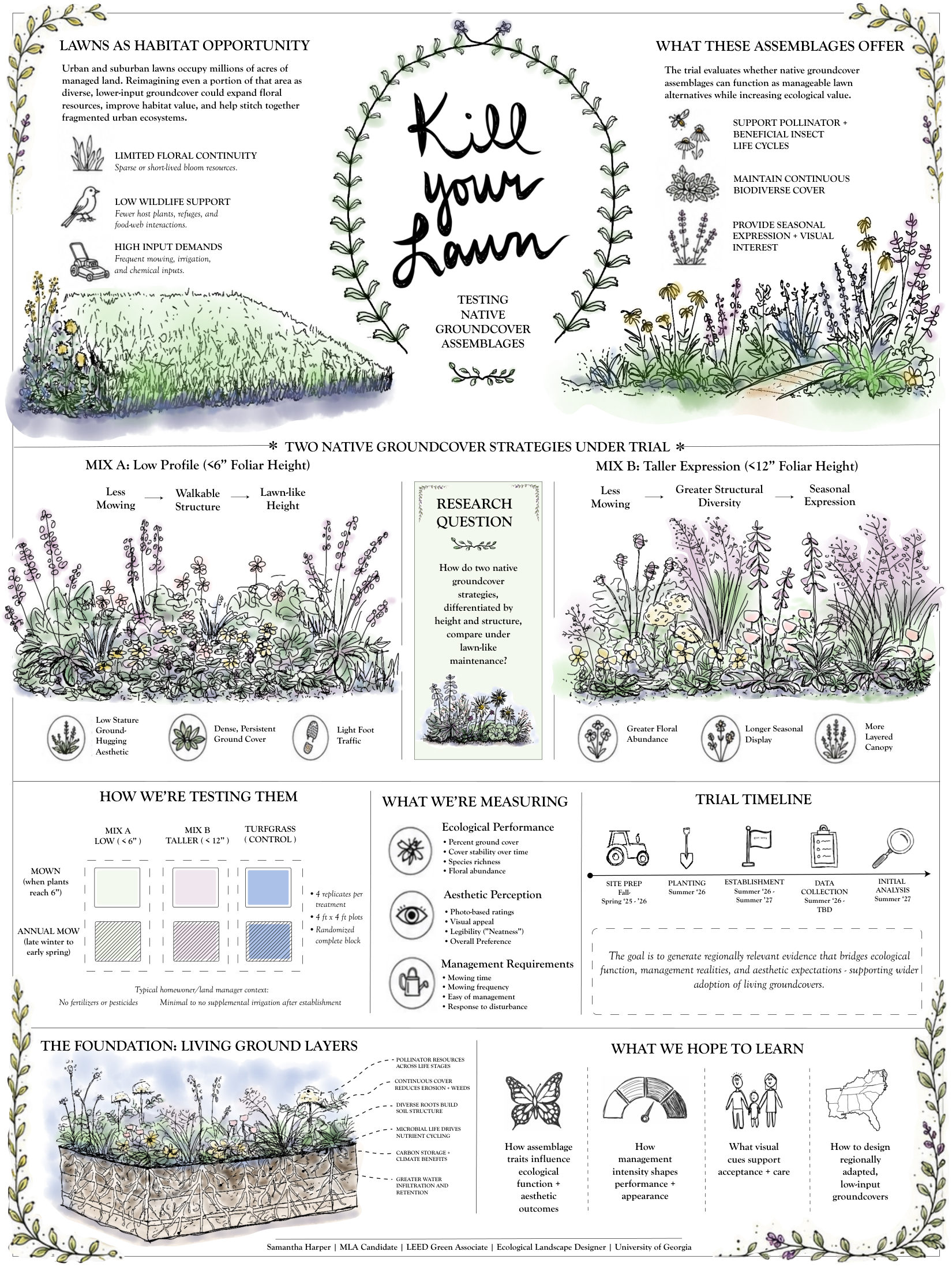
Alt-Lawn Anatomy is an ongoing field study of low-growing native plants in managed assemblages — a working, biodiverse alternative to conventional lawn. The trial examines establishment, coverage, persistence, competition, seasonal appearance, management response, and ecological function, with the goal of expanding the plant palette available for lawn-like landscapes.
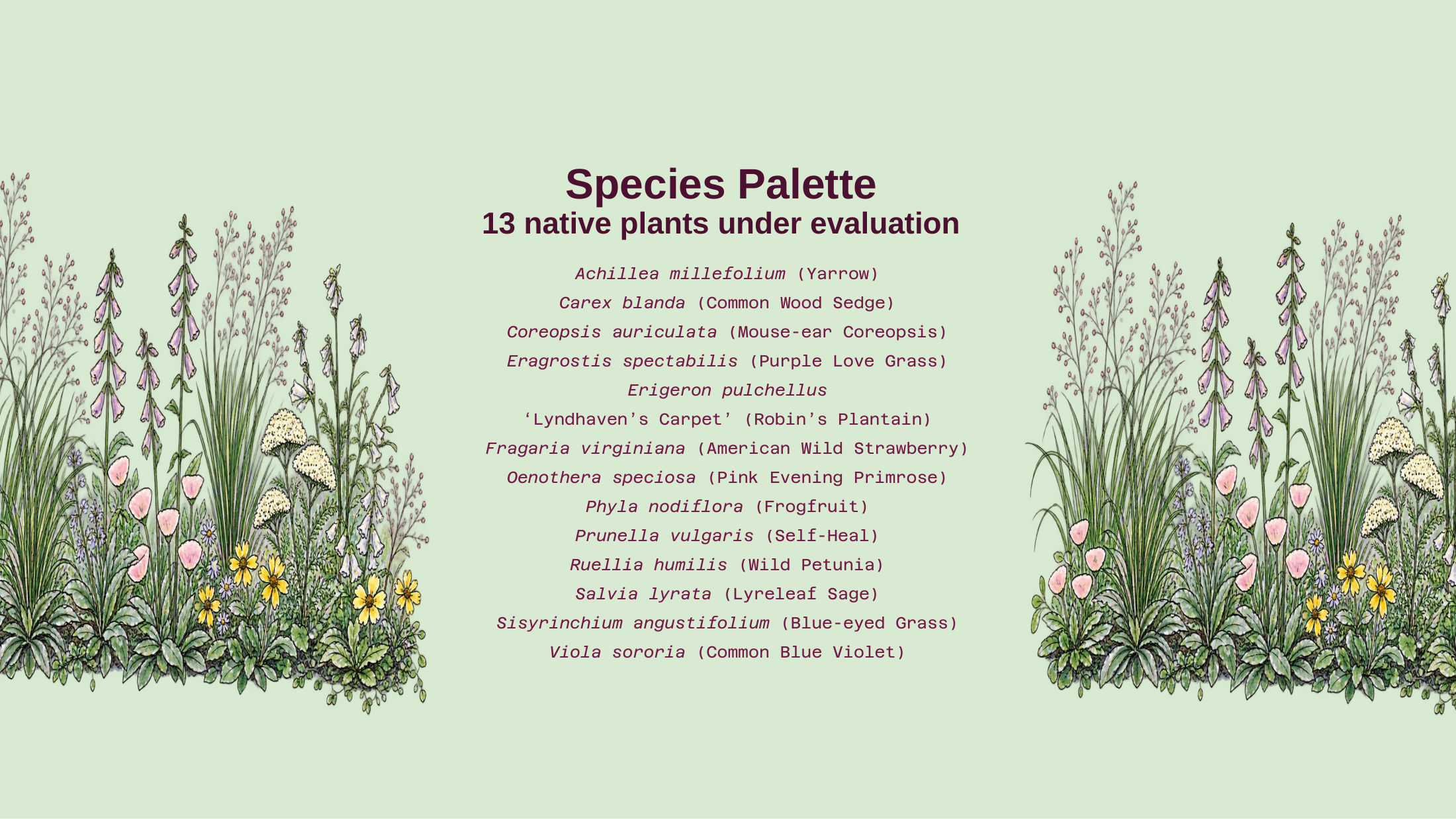
Two assemblages are compared against a conventional turfgrass control: a low-profile mix (≤6″ mature foliage) and a medium-height mix (≤12″). Thirteen native species are under evaluation in the inaugural trial.
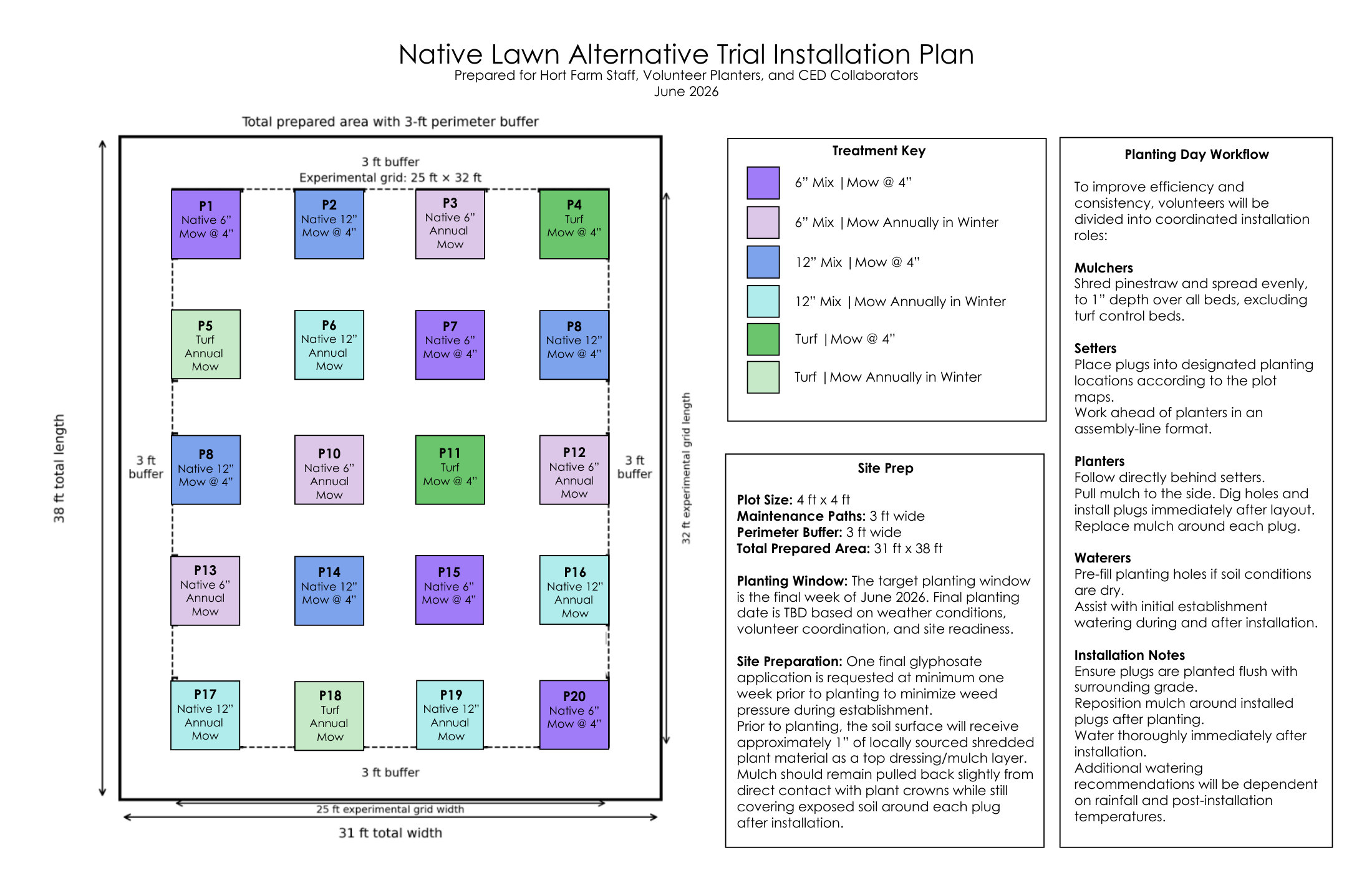
Trial Design & Installation
The experiment is laid out as a randomized complete block: twenty 4 ft × 4 ft plots across a 25 ft × 32 ft grid, testing six treatments — the 6″ and 12″ native mixes and a turfgrass control, each under two mowing regimes (mown at 4″ versus a single annual winter mow).
The Species Under Trial
Sort or filter the assemblage by trait, spread strategy, bloom time, or ecological role.
| Species↕ | Common Name↕ | Foliage Ht.↕ | Flower Ht.↕ | Spread Strategy↕ | Bloom↕ | Winter Foliage↕ | Ecological Role↕ |
|---|---|---|---|---|---|---|---|
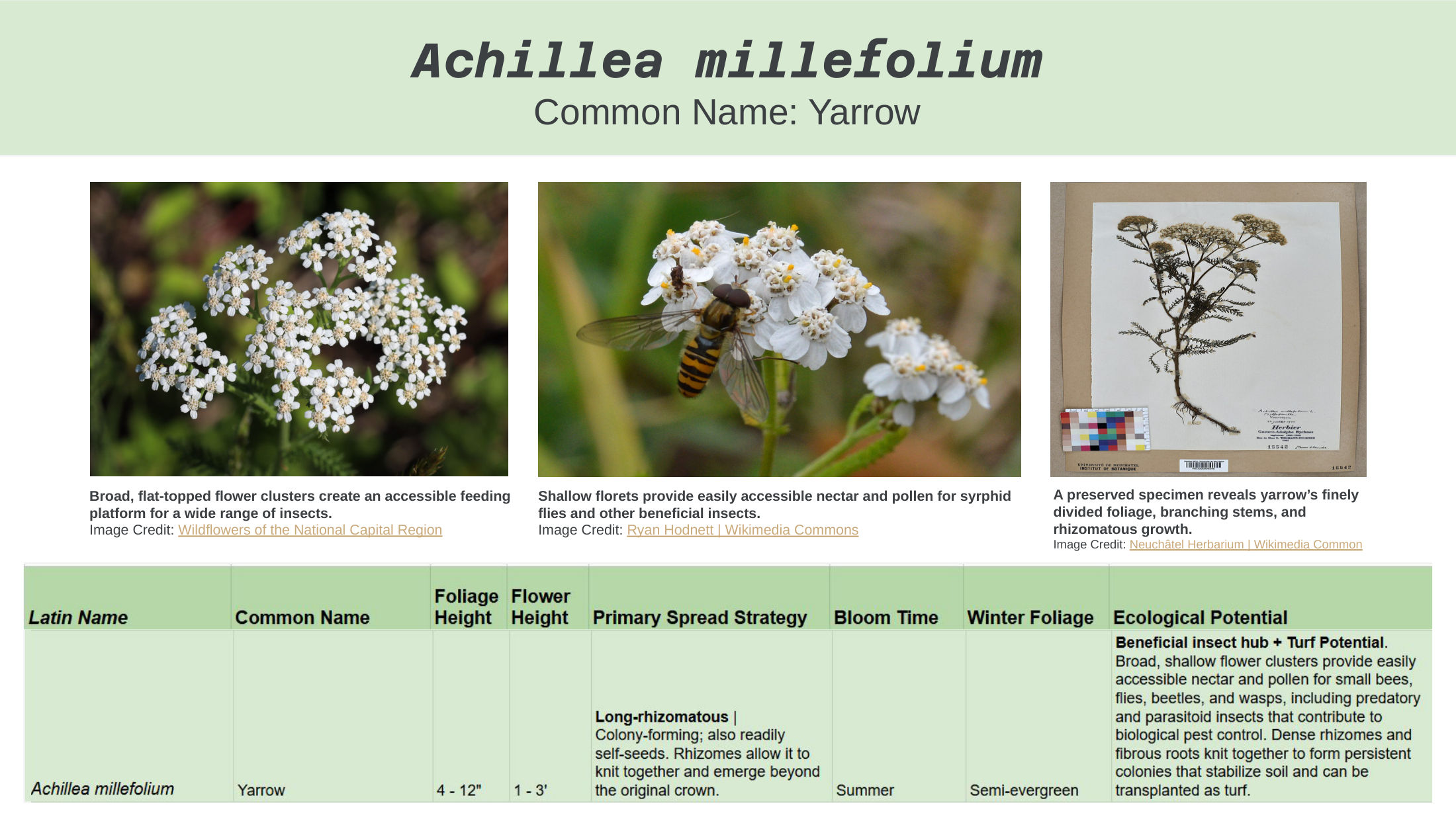
| Achillea millefolium | Yarrow | 4–12" | 1–3' | Long-rhizomatous — colony-forming; also self-seeds | Summer | Semi-evergreen | Beneficial insect hub + turf potential. Broad, shallow flower clusters feed small bees, flies, beetles, and predatory/parasitoid insects; dense rhizomes knit into transplantable turf. |
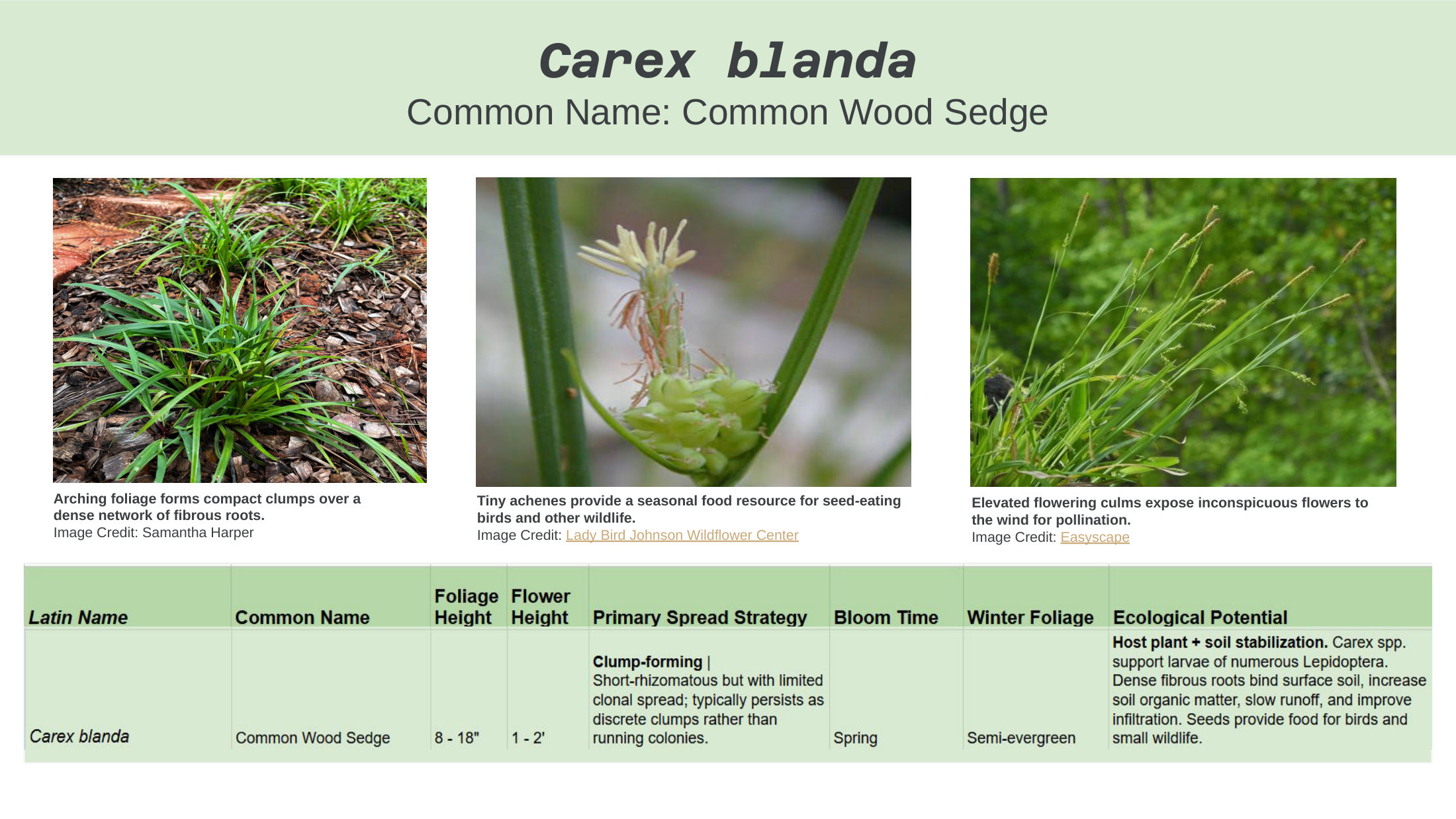
| Carex blanda | Common Wood Sedge | 8–18" | 1–2' | Clump-forming — limited clonal spread | Spring | Semi-evergreen | Host plant + soil stabilization. Supports Lepidoptera larvae; dense fibrous roots bind soil and improve infiltration; seeds feed birds and small wildlife. |
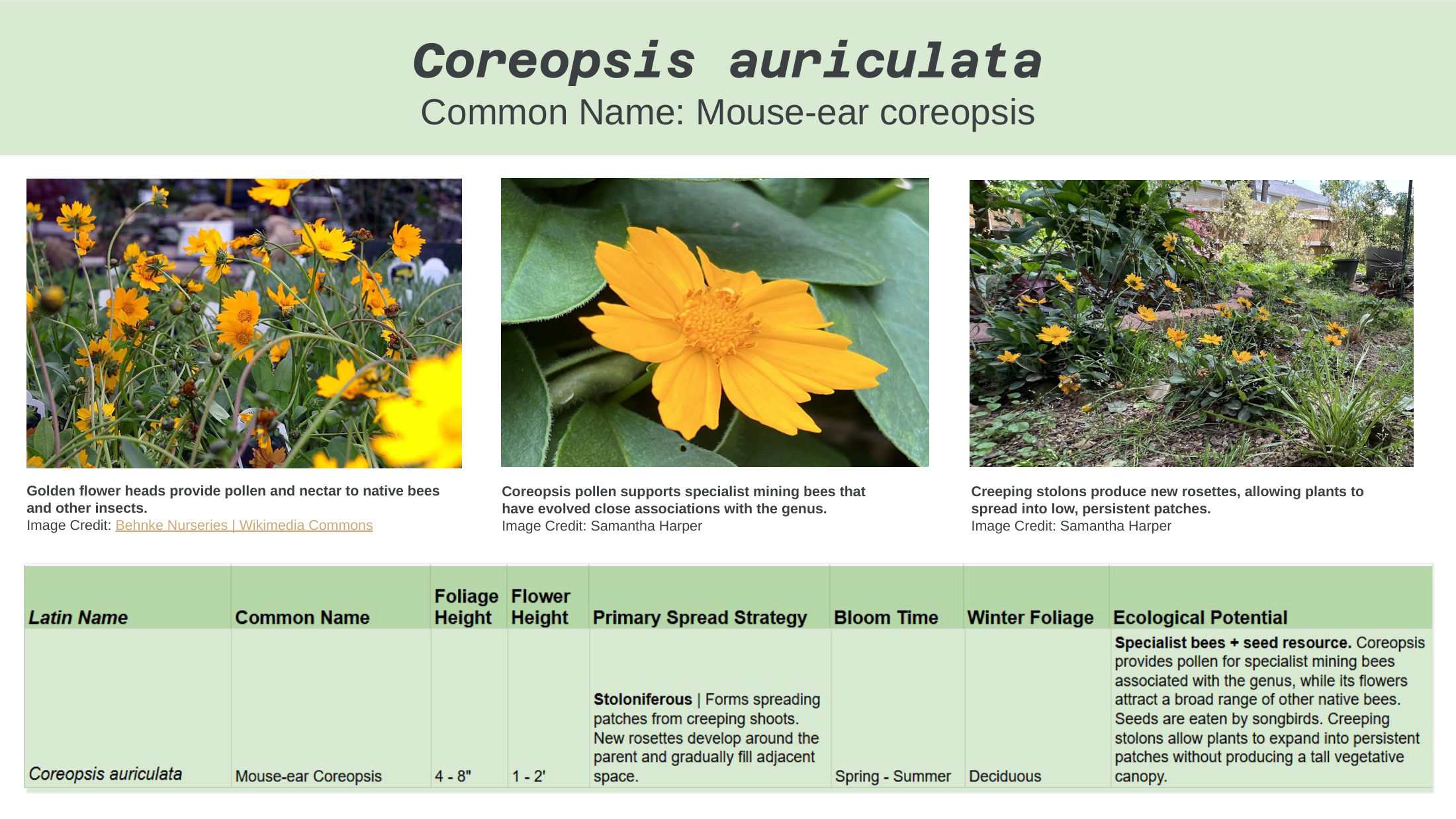
| Coreopsis auriculata | Mouse-ear Coreopsis | 4–8" | 1–2' | Stoloniferous — spreading patches from creeping shoots | Spring–Summer | Deciduous | Specialist bees + seed resource. Provides pollen for specialist mining bees; seeds eaten by songbirds; spreads without a tall vegetative canopy. |
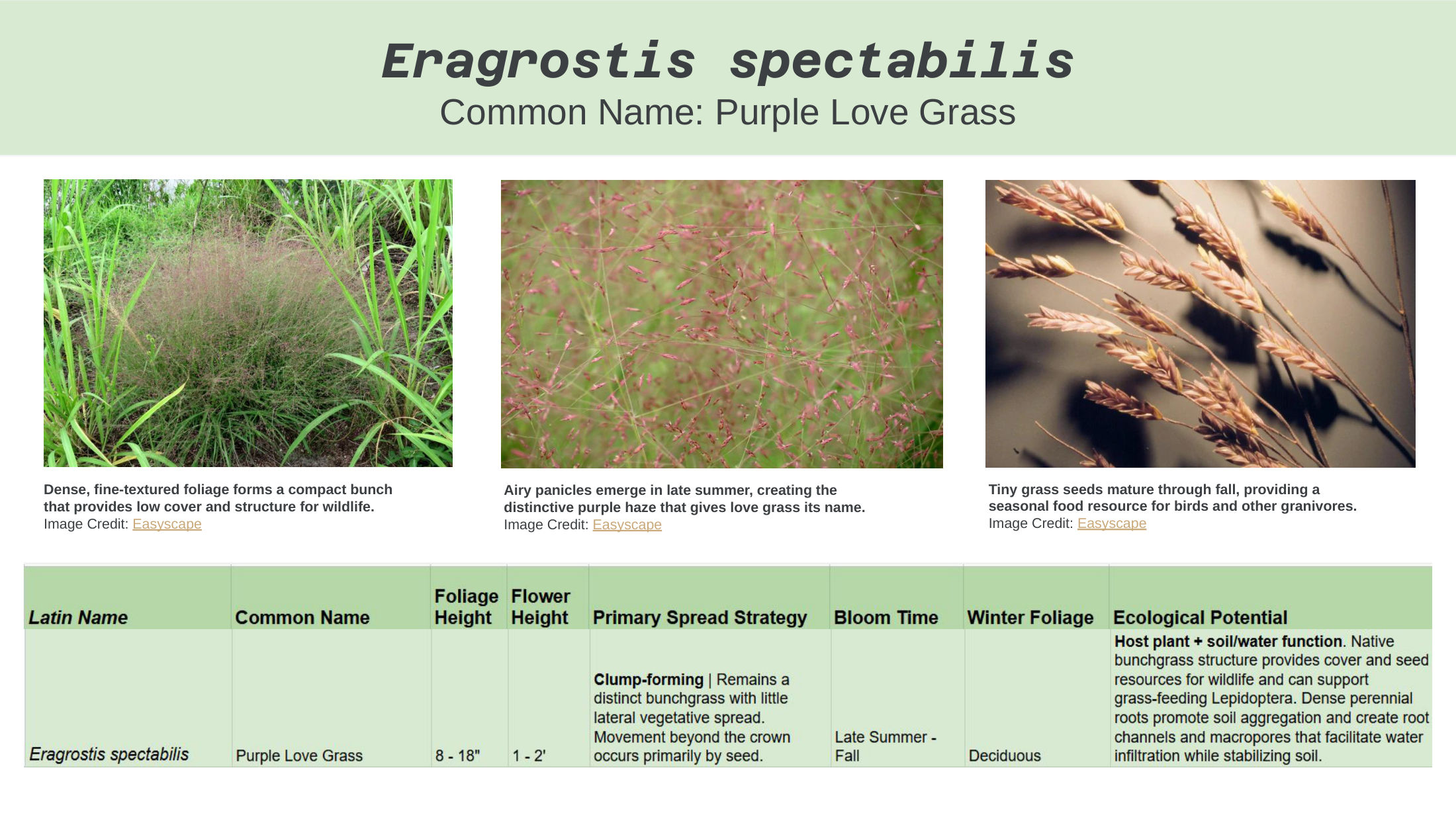
| Eragrostis spectabilis | Purple Love Grass | 8–18" | 1–2' | Clump-forming — bunchgrass; spreads mainly by seed | Late Summer–Fall | Deciduous | Host plant + soil/water function. Native bunchgrass cover and seed for grass-feeding Lepidoptera; roots aid infiltration and stabilize soil. |
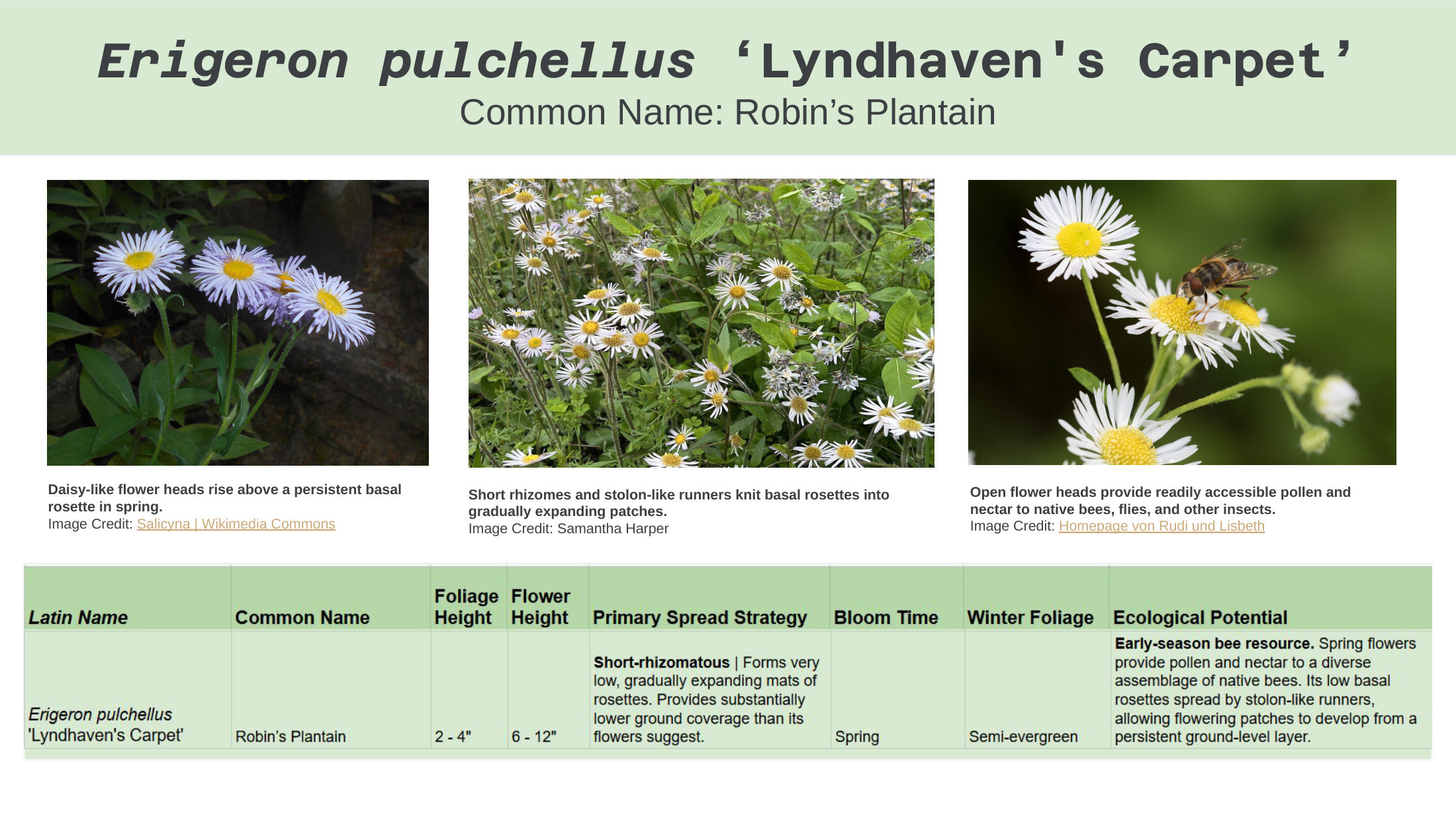
| Erigeron pulchellus 'Lyndhaven's Carpet' | Robin's Plantain | 2–4" | 6–12" | Short-rhizomatous — low mats of rosettes | Spring | Semi-evergreen | Early-season bee resource. Spring flowers feed a diverse assemblage of native bees; stolon-like runners form a persistent ground layer. |
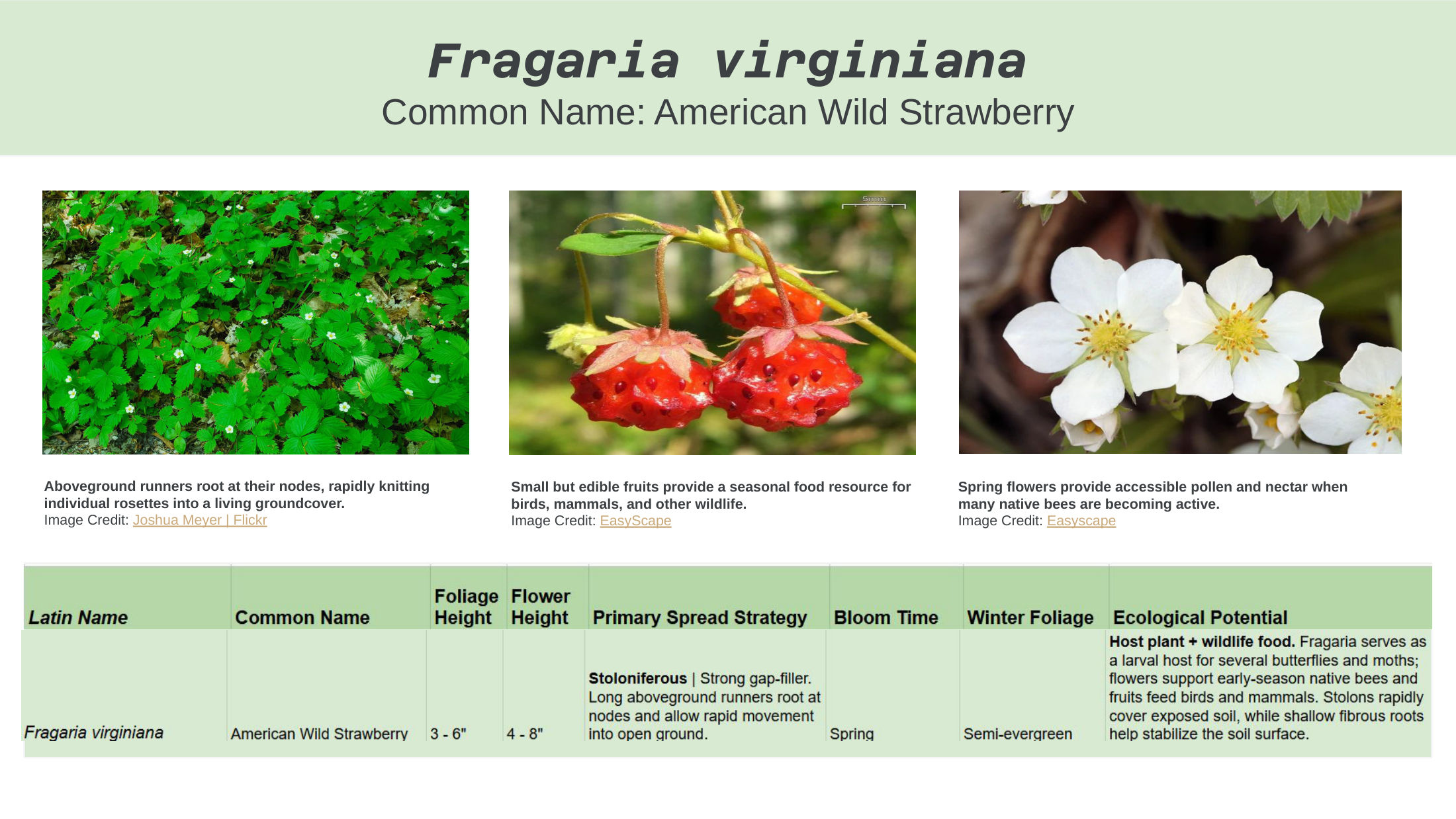
| Fragaria virginiana | American Wild Strawberry | 3–6" | 4–8" | Stoloniferous — strong gap-filler; runners root at nodes | Spring | Semi-evergreen | Host plant + wildlife food. Larval host for butterflies and moths; flowers feed early bees; fruits feed wildlife; roots stabilize soil. |
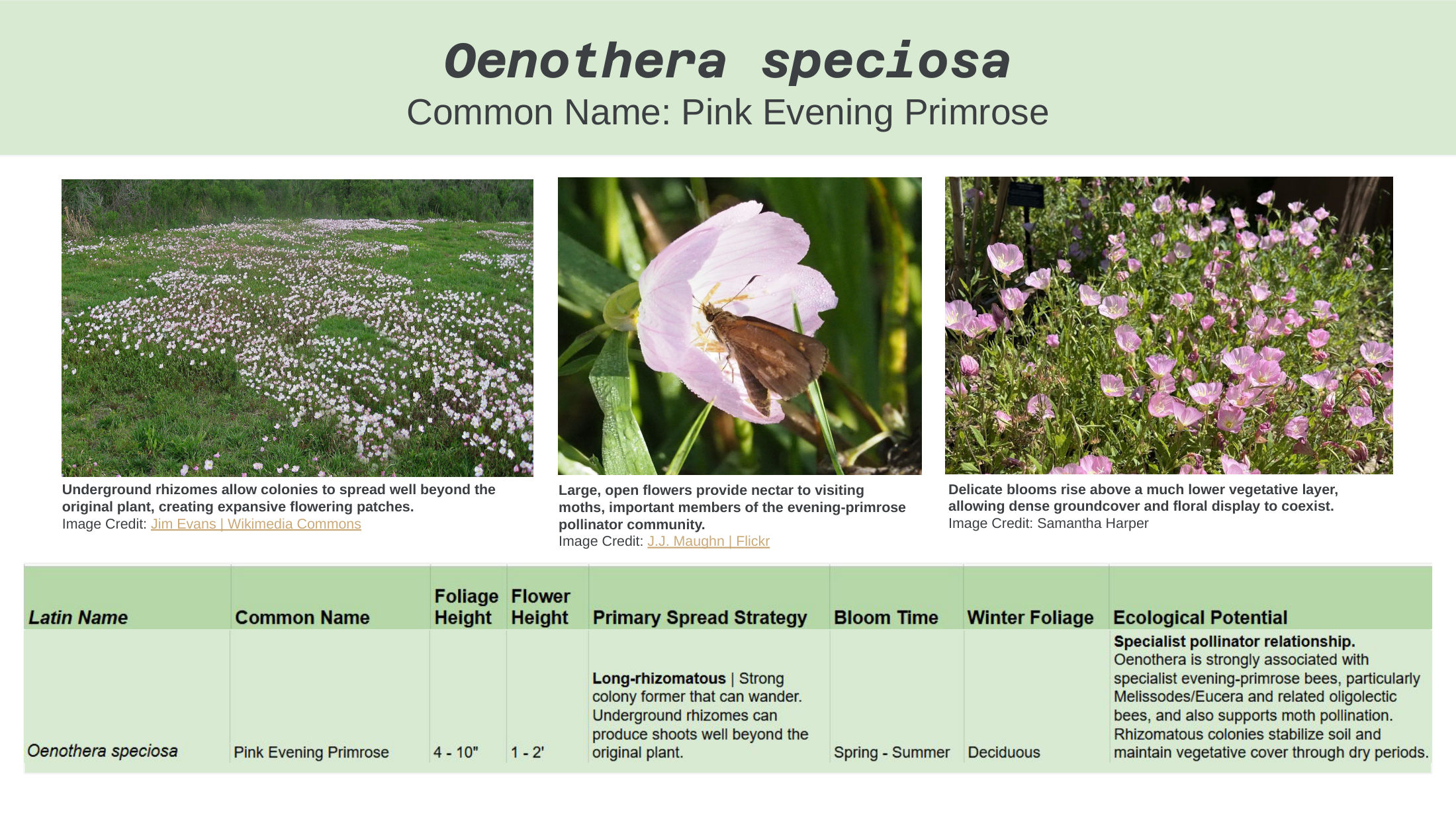
| Oenothera speciosa | Pink Evening Primrose | 4–10" | 1–2' | Long-rhizomatous — strong, wandering colony former | Spring–Summer | Deciduous | Specialist pollinator relationship. Strongly associated with evening-primrose bees; rhizomatous colonies hold soil and cover through dry periods. |
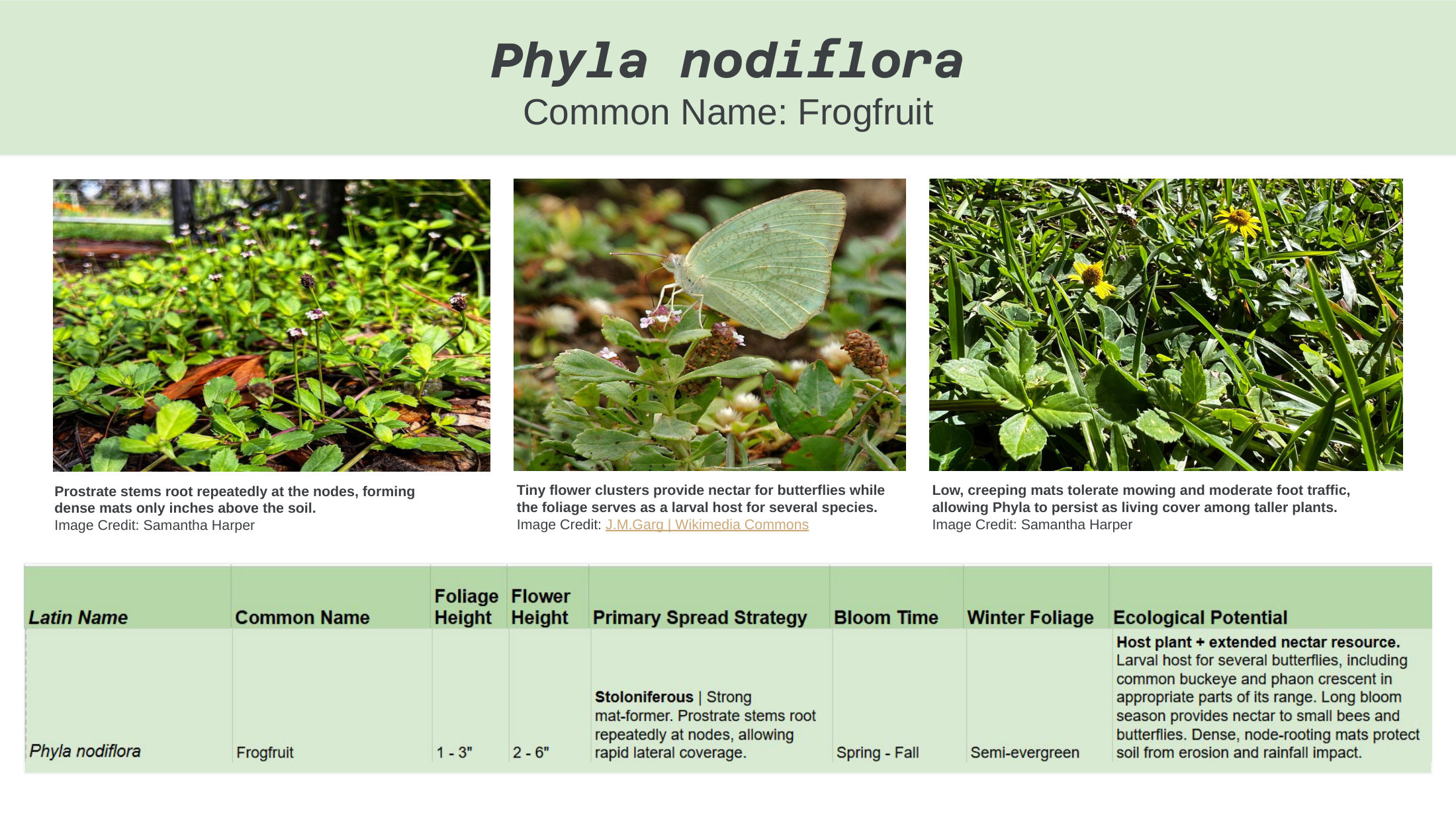
| Phyla nodiflora | Frogfruit | 1–3" | 2–6" | Stoloniferous — strong mat-former; roots repeatedly | Spring–Fall | Semi-evergreen | Host plant + extended nectar. Larval host for common buckeye and phaon crescent; long bloom feeds small bees; mats protect soil from erosion. |
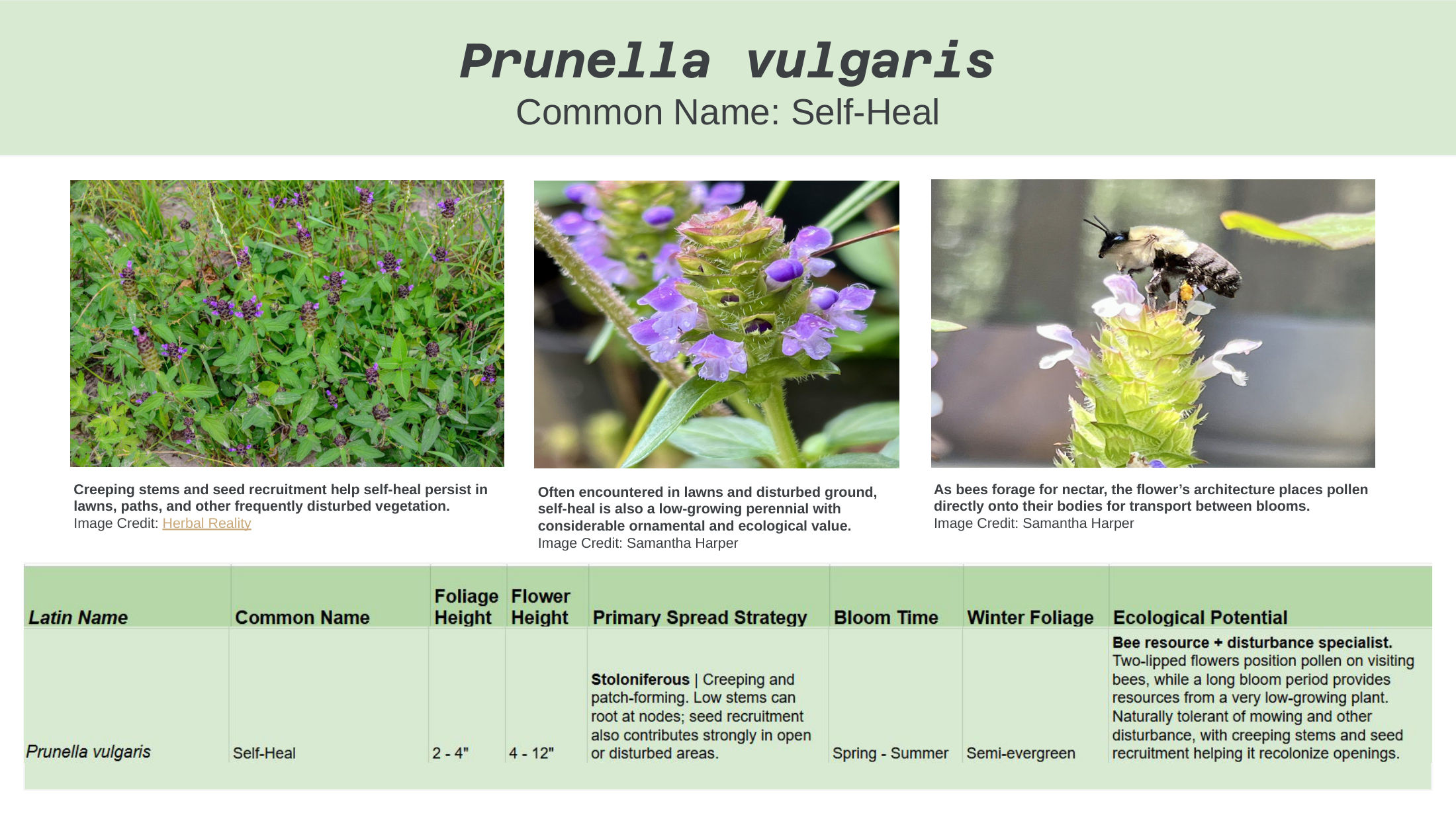
| Prunella vulgaris | Self-Heal | 2–4" | 4–12" | Stoloniferous — creeping and patch-forming | Spring–Summer | Semi-evergreen | Bee resource + disturbance specialist. Long bloom feeds visiting bees; tolerant of mowing and disturbance, recolonizing openings by seed and stems. |
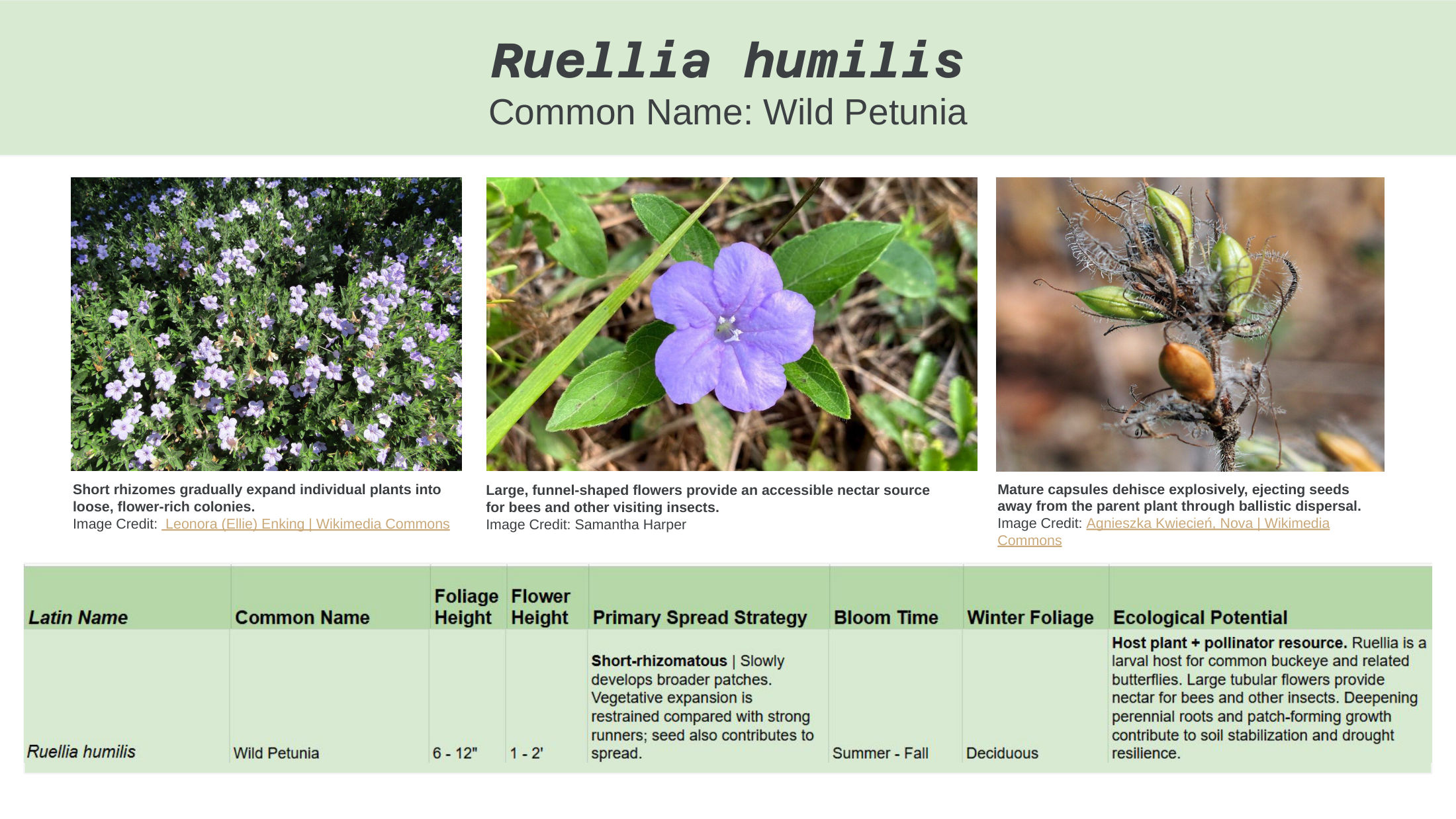
| Ruellia humilis | Wild Petunia | 6–12" | 1–2' | Short-rhizomatous — slowly broadening patches | Summer–Fall | Deciduous | Host plant + pollinator resource. Larval host for common buckeye; large tubular flowers feed bees; deep roots aid soil stability and drought resilience. |
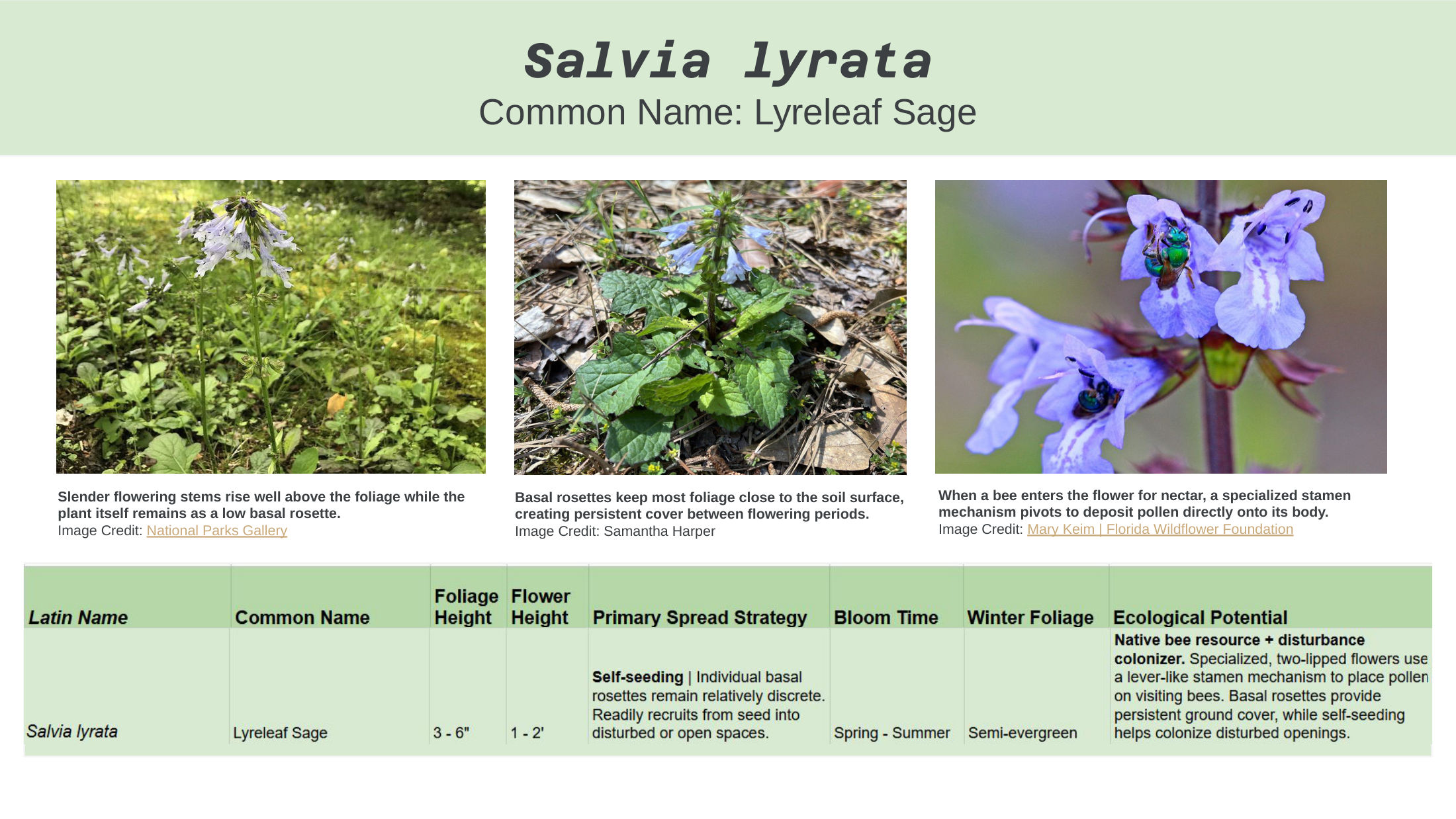
| Salvia lyrata | Lyreleaf Sage | 3–6" | 1–2' | Self-seeding — discrete basal rosettes; recruits from seed | Spring–Summer | Semi-evergreen | Native bee resource + colonizer. Lever-arm stamen places pollen on visiting bees; rosettes hold ground while self-seeding colonizes openings. |
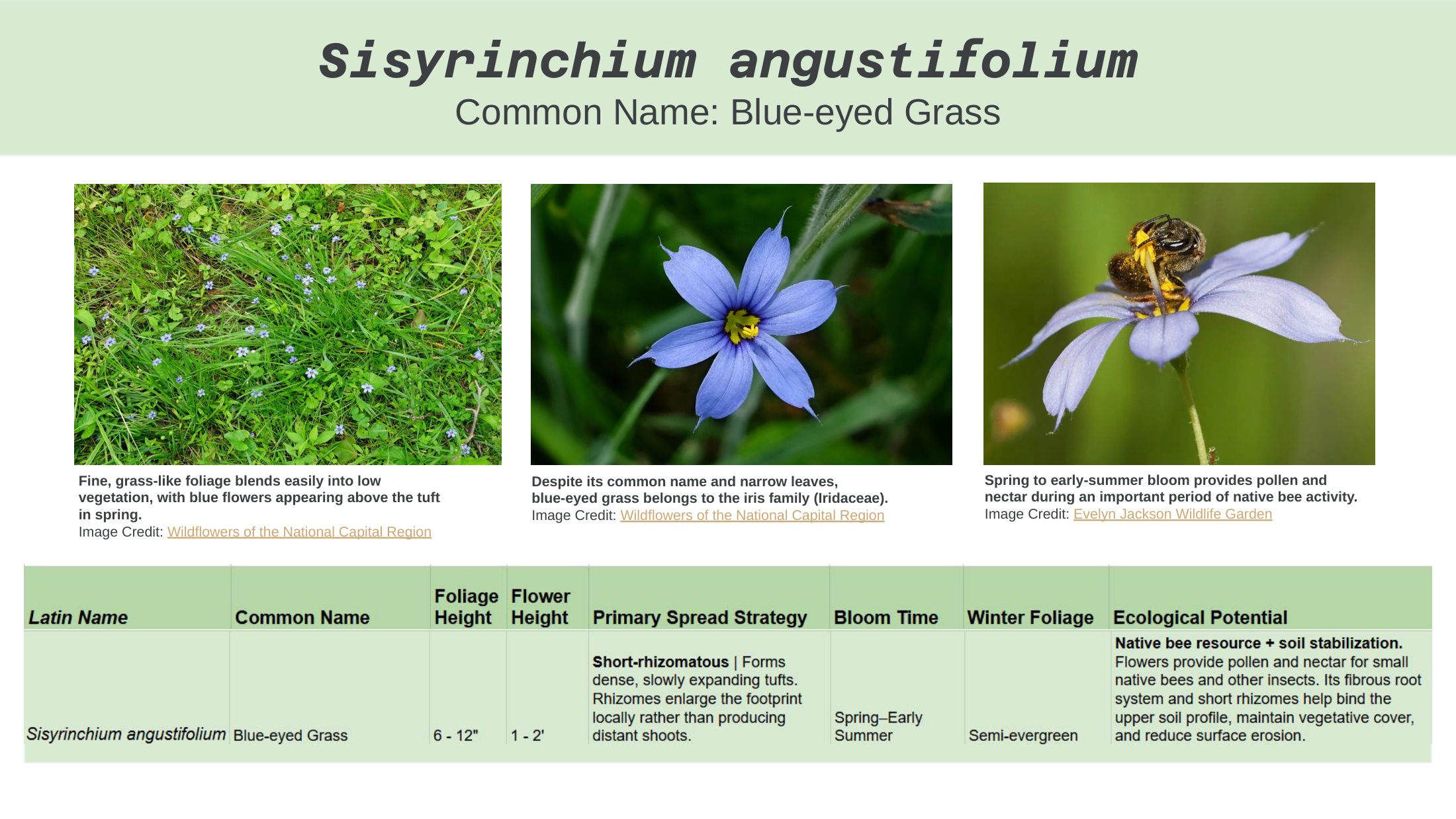
| Sisyrinchium angustifolium | Blue-eyed Grass | 6–12" | 1–2' | Short-rhizomatous — dense, slowly expanding tufts | Spring–Early Summer | Semi-evergreen | Native bee resource + soil stabilization. Flowers feed small native bees; fibrous roots and short rhizomes bind the upper soil profile. |
| Viola sororia | Common Blue Violet | 3–6" | 4–8" | Short-rhizomatous — local spread + strong seed recruitment | Spring | Semi-evergreen | Essential fritillary host. Sole larval food of fritillary butterflies; early flowers feed spring insects; cleistogamous flowers reliably set seed. |
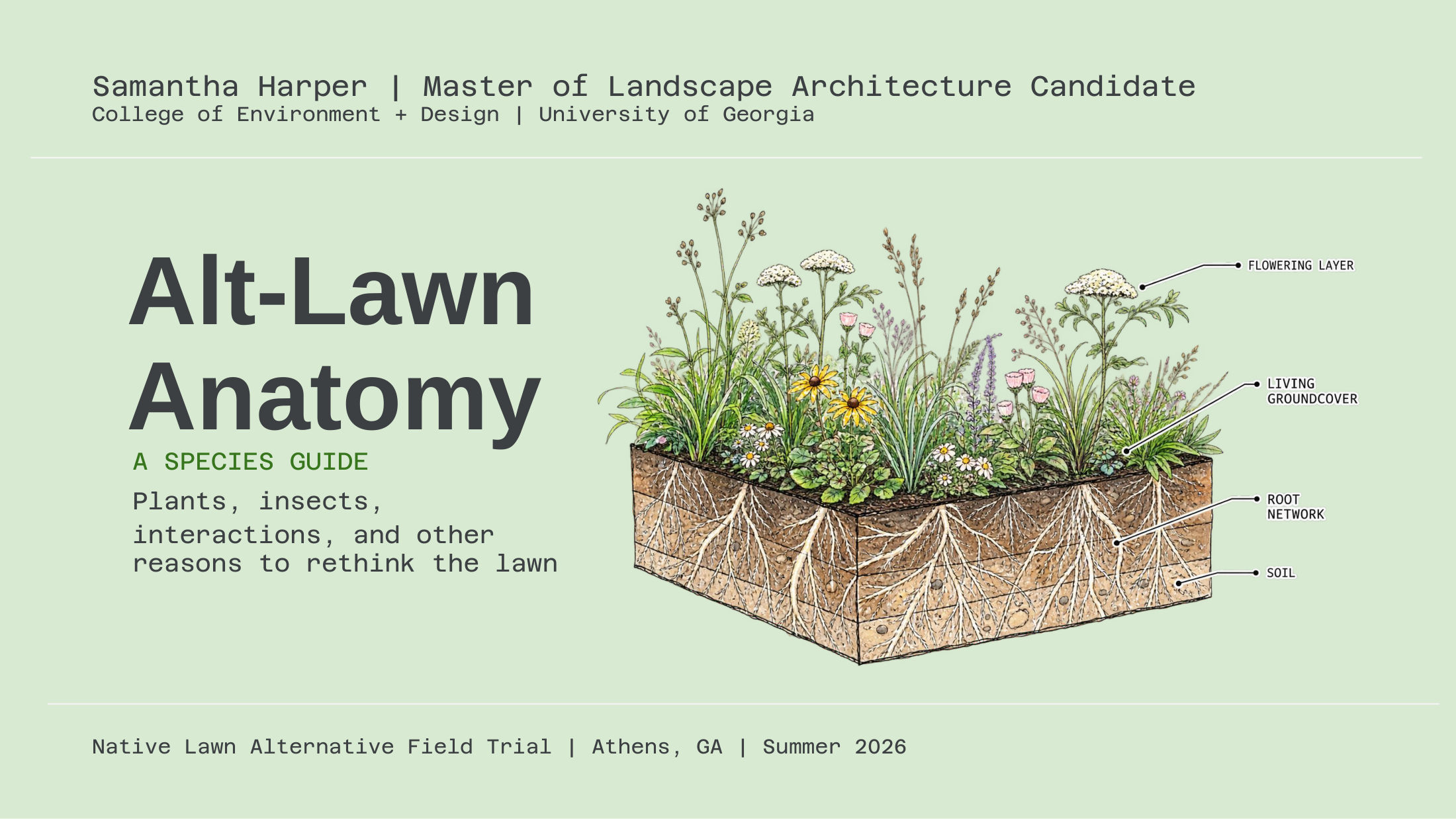
Alt-Lawn Anatomy — A Species Guide
Each species is documented with field and reference photography. Click any slide to explore the full guide.
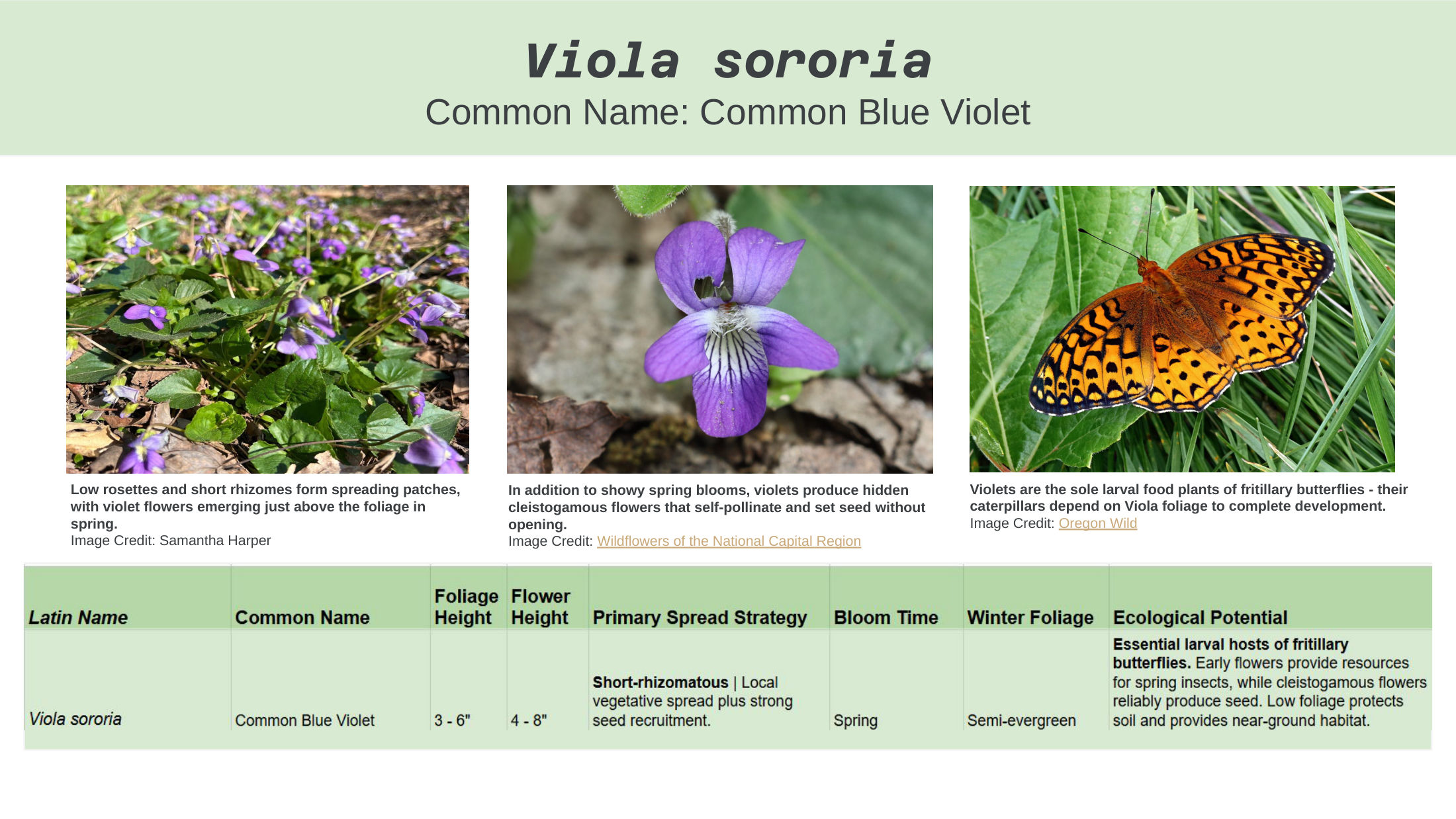
The research framework behind the trial is laid out in the companion project, Alternative Lawns for LEED.
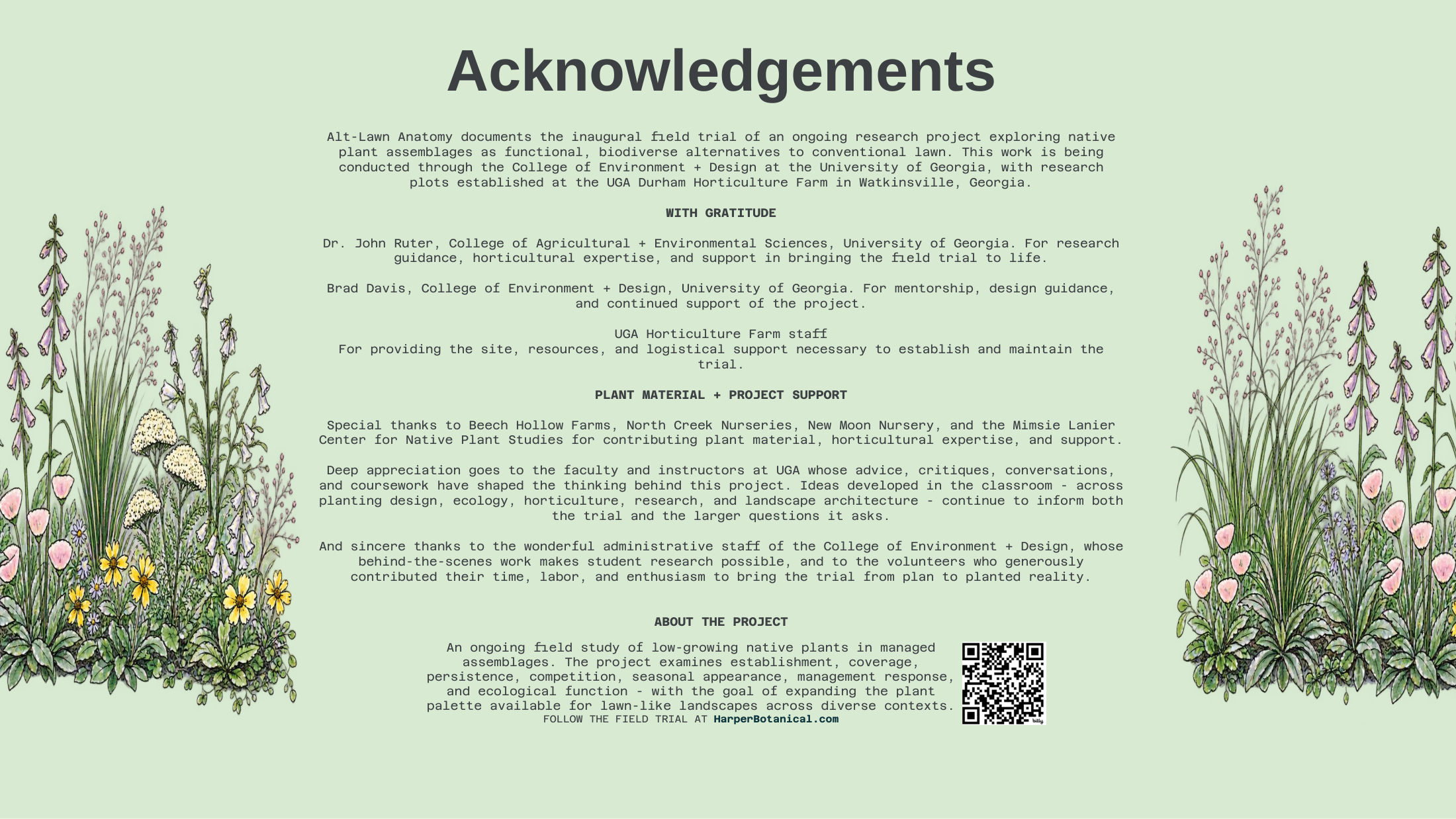
Field trial conducted through the UGA College of Environment + Design at the Durham Horticulture Farm in Watkinsville, Georgia, with plant material and support from Beech Hollow Farms, North Creek Nurseries, New Moon Nursery, and the Mimsie Lanier Center for Native Plant Studies.
← All projects